Europe wildfires 2026: travel alerts, maps and what to do
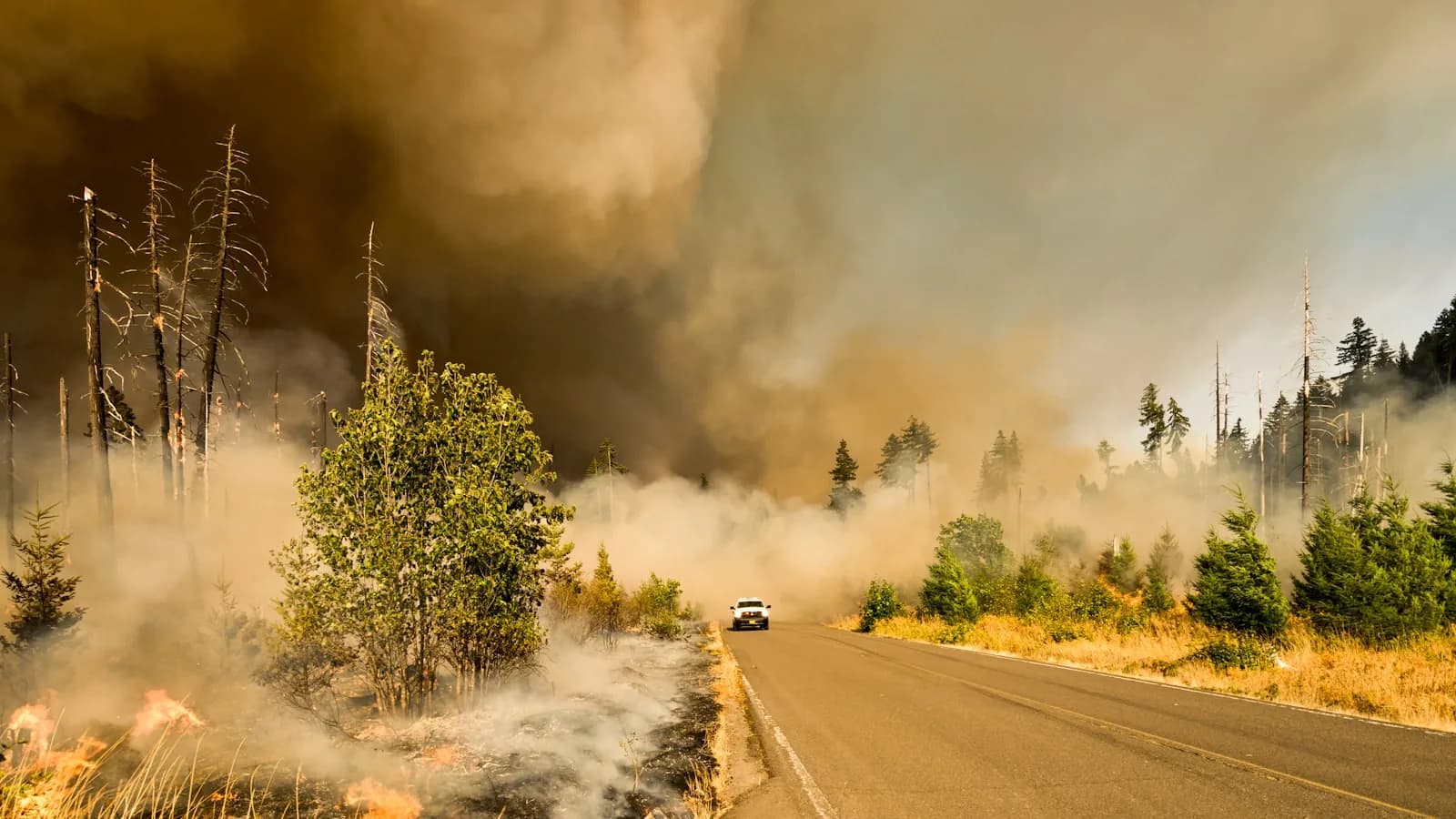
Photo: Marcus Kauffman on Unsplash, used under the Unsplash License. The photo was taken during the Jones Fire in Oregon in 2017 and is illustrative, not a picture of the current European fires. Cropped and compressed for this guide.
Do not cancel or continue a Europe trip based on a continent-wide headline. Check the exact town, transport route and accommodation against current local instructions. If an authority orders an evacuation, closes access or tells visitors to delay travel, change the plan. An old screenshot, a social post and a general fire-risk map cannot overrule local emergency services.
This guide was checked on July 28, 2026. Conditions can change within hours. Use it as a preparation and decision workflow, then use the linked official sources for the live situation.
What is happening in France and Spain
France and Spain are dealing with fires on an exceptional scale. On July 27, the Associated Press reported that more than 300,000 people had been evacuated across the two countries. The report also noted restrictions around popular summer destinations and further heat that could complicate firefighting.
The figures will move as authorities revise fire perimeters and evacuation totals. For the broader picture, the EU's European Forest Fire Information System provides daily hotspot and fire-perimeter maps, a fire-danger forecast up to six days ahead and current-season statistics. EFFIS is useful for orientation. It is not an evacuation service and should not be used to choose an escape route.
The EU Joint Research Centre reported on July 22 that the number of EU fires detected in 2026 was more than double the long-term average for the same point in the year. That is a reason to prepare carefully, not a reason to assume every part of France, Spain or southern Europe is unsafe.
Check these sources before deciding whether to travel
Use sources in this order. A local evacuation message is more important than a national forecast, while a transport operator knows more about a specific train than a general travel article.
| What you need to know | Best place to check | What it can tell you |
|---|---|---|
| Immediate danger or evacuation | Local civil protection, prefecture, police, fire service or municipal alert | Whether to leave, shelter, avoid a road or stay away from an area |
| Fire location and short forecast | EFFIS Current Situation Viewer | Hotspots, mapped perimeters and fire-danger forecasts across Europe |
| France alerts | FR-Alert, the relevant prefecture and Meteo-France | Emergency phone messages, local orders and weather warnings |
| Spain alerts | Spain's civil protection alert system, AEMET and the relevant autonomous community | ES-Alert messages, fire weather and regional instructions |
| Portugal alerts | ANEPC public warnings and IPMA fire danger | Civil protection notices and daily municipal fire risk |
| Rail, road or flight status | The operating airline, rail company, infrastructure manager or road authority | Whether the booked service is running and which alternatives are accepted |
| Advice for your nationality | Your government's current foreign travel advice | Consular contacts, insurance implications and any official warning level |
| Smoke and health | Local health authority and the European Air Quality Index | Current air quality and public-health instructions |
The current UK travel advice for France says roads can close at short notice and tells travelers to check with their accommodation or travel provider before setting out. Australian advice for Spain likewise tells visitors to stay away from affected areas and follow local authorities. These are useful examples, but use the advisory issued for your own passport and insurance arrangements.
Should you cancel or change your Europe trip?
There is no honest yes-or-no answer for an entire country. Make the decision at town and route level.
- Check the accommodation address against the latest local order. Ask the property directly whether it is open, accessible and accepting arrivals.
- Check every transport segment with the actual operator. For rail, also check the infrastructure manager where one publishes closure information.
- Read your government's travel advice and your policy wording before cancelling. A heatwave or nearby fire does not automatically create a refund right.
- Consider the needs of everyone traveling. Smoke, extreme heat, limited cooling and a rushed evacuation can affect children, older people, pregnant travelers and people with heart or lung conditions differently.
- Keep a second route and a place to stay outside the affected area. A backup that depends on the same road is not a backup.
Change the trip if authorities advise against travel, the accommodation cannot receive you, the route is closed or your group cannot safely manage the current conditions. If the destination is far from the fire and has no local warning, keep monitoring rather than treating a national news headline as a local order.
Trains, flights and driving near a wildfire
Travelers are asking whether trains from Paris toward southwest France will run and what happens when Spanish rail lines close. The answer can change after a ticket app has cached an itinerary.
For France, check the operating train in SNCF Connect and read any service notice issued for the route. For Spain, check Renfe for the train and Adif for infrastructure disruption. A third-party journey planner may not show an emergency closure or an accepted replacement bus quickly enough.
Airports outside a fire zone can still experience smoke, airspace restrictions, crew disruption or road closures on the way to the terminal. Check the airline's app and the airport's own departure board before leaving the hotel. Do not assume a flight is cancelled because a nearby road is closed, and do not assume a scheduled flight means the road to the airport is open.
If you are driving, follow police barriers and local diversion signs. Do not drive toward smoke to collect luggage or inspect an accommodation. An offline map can show roads and towns, but it cannot confirm that a road remains safe. During an evacuation, use the route given by emergency services even when navigation suggests a faster one.
How emergency alerts reach a travel phone
France's FR-Alert and Spain's ES-Alert use cell broadcast. The warning is sent through mobile network antennas to compatible phones in the affected cells. It is not an ordinary text message and does not use your mobile-data allowance.
The French Interior Ministry says FR-Alert needs no app or registration. Spain says ES-Alert works over 4G and 5G and that its highest civil-protection alert level is enabled by default on supported phones. Portugal also uses location-based public warning texts in some emergencies.
EU guidance says most member states can send cell-broadcast or location-based warnings to people using roaming services without requiring them to sign up. Phone support, national implementation, message language and local coverage still vary, so do not rely on one alert channel.
Before entering a high-risk area:
- Update the phone and confirm government or emergency alerts are enabled.
- Keep the phone powered on and connected to a mobile network. Airplane mode prevents the phone from receiving a network alert.
- Keep the regular voice and SMS line active if practical. Turn off mobile data on that line if you need to avoid home-carrier data charges.
- Use a Roaming eSIM for travel data only after confirming what the selected plan includes. A data-only plan does not become a voice or SMS service during an emergency.
- Save the accommodation address, emergency contacts and insurance details outside the browser.
- Carry a charged power bank and a cable that fits the phone.
In the EU, 112 is the shared emergency number. A data-only Roaming eSIM is not a substitute for a working voice line. Keep access to ordinary calling where possible, and learn any accessible emergency contact method used in the country you are visiting.
Apps and downloads worth setting up
No single app covers every European fire, road closure and evacuation order. Use a short stack that matches the itinerary.
- EFFIS Current Situation Viewer for the Europe-wide fire picture and forecast
- The official civil protection, weather and transport sources for each country on the route
- The airline, rail and accommodation apps, already signed in
- Google Maps, Apple Maps or another trusted navigation app with the relevant area downloaded
- An air-quality app or the European Air Quality Index when smoke is a concern
- An offline translation language for local alert text and conversations with staff
Open every important screen once before leaving reliable WiFi. Save the ticket, hotel address, passport copy, insurance policy, medication list and a route to a staffed public place. Screenshots are useful for reference, but do not keep following a screenshot after authorities issue a newer instruction.
What to keep ready if you may need to leave
Pack the items that are hard to replace in one reachable bag:
- Passport or identity document
- Essential medication and prescription details
- Phone, cable and power bank
- Water and any food needed for children or a medical condition
- Payment card and some local cash
- Keys, glasses, hearing-device supplies and mobility aids
- Basic items for a baby, service animal or pet
- Accommodation address, transport booking and emergency contacts on paper
Ask the accommodation how it communicates an evacuation and where guests should assemble. If anyone needs step-free transport, hearing support, medication refrigeration or help moving quickly, raise it before an alert. A fire drill designed for an independent adult may not fit every guest.
Do not wait for a perfect English translation if a local alarm, staff instruction and visible evacuation are all telling people to leave. Move with the directed evacuation and ask for clarification from officials at the safe point.
Smoke and heat can matter beyond the fire perimeter
Smoke can affect a town that is not under evacuation. The WHO Regional Office for Europe advises people in affected areas to use official information, reduce unnecessary travel and get medical help when symptoms are concerning. Local health authorities should guide decisions about masks, indoor air and medication.
This article cannot assess an individual's medical risk. If someone in the group has a heart or lung condition, is pregnant, is very young or is older, ask a qualified clinician how smoke and extreme heat affect that person before traveling. Check whether the accommodation has effective cooling rather than assuming that "air conditioning" means every room stays cool during a prolonged heatwave.
Where a Roaming eSIM helps, and where it does not
A Europe Roaming eSIM can keep official maps, transport notices, accommodation messages and translation tools available while you move between included countries. It cannot guarantee cell-broadcast alerts, voice calls, network capacity, road access or service inside an evacuation zone.
Compare the Europe Roaming eSIM with a country plan when the trip stays in one destination. Install the plan at the time described in the Roaming eSIM setup guide, and check the travel data calculator rather than buying a large allowance by reflex.
Keep the home line if you need ordinary calls, verification texts or location-based warning messages. The calls and SMS guide explains the difference between a data-only plan, internet calling and carrier voice service. Add the phone steps here to the broader Europe travel checklist before departure.
Europe wildfire travel questions
Should I cancel a Europe trip because of the wildfires?
Check the exact destination, route and dates. Change the trip when local authorities advise against travel, access is closed, the accommodation cannot receive you or your group cannot safely manage the smoke and heat. A warning for one region does not automatically apply to an entire country.
Where can I see a live Europe wildfire map?
Use the EFFIS Current Situation Viewer for hotspots, perimeters and fire-danger forecasts. Then check the local civil protection authority before making a safety decision. EFFIS does not issue evacuation routes.
Will an emergency alert reach a phone with a Roaming eSIM?
It may. Cell-broadcast warnings are sent to compatible phones connected to participating local networks, while some countries use location-based texts or apps. Keep emergency alerts enabled, keep the phone connected to a network and retain the regular SIM when practical. Never depend on one alert method.
Can offline maps show wildfire road closures?
No. They can show the road network and help with orientation, but they do not prove that a road is open or safe. Follow emergency-service routes and current operator notices.
What should I do if my train is cancelled because of a fire?
Read the operating rail company's notice before buying another ticket. Check whether the operator offers rebooking, a replacement service or a refund, then verify the alternative with the infrastructure manager or station staff. Leave enough time for slower buses and full departures.
Does travel insurance cover a wildfire cancellation?
Coverage depends on the policy, the date it was purchased, the official advice and whether the airline or accommodation is still operating. Contact the insurer before cancelling unless you must leave immediately for safety.
The useful question is not whether Europe is open. It is whether your exact route is open, your accommodation is safe and your group can receive and act on current instructions. Check those three things again on the day you travel.